

From 1 July 2028, the Government is introducing a 30% minimum tax on discretionary trust income.
Under the changes, the trustee will be responsible for paying the minimum tax. Beneficiaries will continue to declare their trust income in their tax returns, with non-corporate beneficiaries receiving non-refundable tax credits recognising tax already paid by the trustee.
The Government says the change is intended to create greater consistency between the tax paid on discretionary trust income and the tax rates paid by workers.
Q. What changes were announced for discretionary trusts and why?
The Budget announced a new 30% minimum tax on discretionary trust income from 1 July 2028.
Under the proposal:
- trustees will pay a minimum 30% tax on trust income
- non-corporate beneficiaries will receive non-refundable tax credits recognising tax already paid by the trustee
The Government says the measure is intended to improve fairness in the tax system.
Q. Why is this significant?
The proposal represents a significant change to how discretionary trusts are taxed.
Currently, trust income distributed to beneficiaries is generally taxed at each beneficiary’s applicable marginal tax rate. Under the proposed changes, a minimum 30% tax will apply at the trust level.
This will reduce some of the tax flexibility traditionally associated with discretionary trusts.
Q. How do discretionary trusts currently work?
A discretionary trust is a structure where a trustee holds and manages assets for beneficiaries and generally has discretion over which beneficiaries receive trust income or capital, and how much they receive.
Currently, the trustee determines how trust income is distributed among eligible beneficiaries.
Beneficiaries who are entitled to a share of the trust income generally include that amount in their own tax return and pay tax at their applicable marginal tax rate. Different rules can apply where income is retained in the trust or distributed to certain beneficiaries, including children.
Q. What will the changes mean?
Trustees will continue to determine how trust income is distributed, and beneficiaries will continue to include their trust distributions in their income tax returns.
The key difference is that the trustee will pay a minimum 30% tax on the trust’s taxable income. Non-corporate beneficiaries will receive non-refundable tax credits recognising the tax already paid by the trustee.
Trustees will also have additional reporting responsibilities, including calculating and paying the minimum tax and advising beneficiaries of their entitlements and associated tax credits.
Some of the mechanics are still subject to consultation and will be finalised before the changes commence.
Q. How will the changes affect corporate beneficiaries?
Currently, discretionary trusts can distribute income to corporate beneficiaries, sometimes referred to as “bucket companies”, where corporate tax rates can apply.
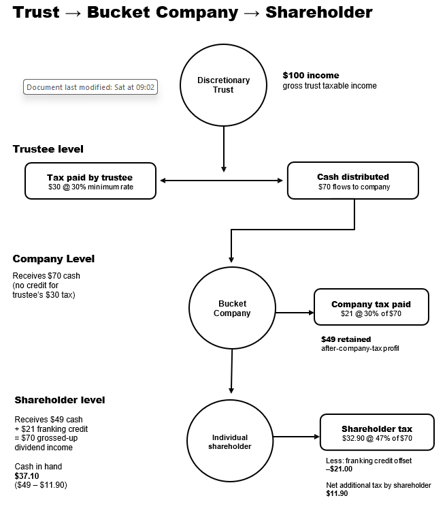
Under the proposed changes, corporate beneficiaries will not receive a credit for the minimum tax paid by the trustee. The Government says this is designed to prevent the minimum tax from being avoided by distributing trust income through a corporate beneficiary.
As a result, the changes are expected to reduce the tax benefit of using corporate beneficiaries solely to receive discretionary trust distributions.
Here is an example of a distribution that will flow from a trust to a bucket company.
| Tax Component | Amount | Rate / Basis | Cumulative Tax |
| Trustee minimum tax | $30.00 | 30% pf $100 | $30.00 |
| Company tax | $21.00 | 30% of $70 | $51.00 |
| Shareholder net top-up | $11.90 | 47% of 70 less $21 credit | $62.90 |
| Total Effective Tax Rate | 62.90% | $62.90 |
Q. Will small business be affected?
Potentially. Small businesses operating through discretionary trusts may need to review how income is paid or distributed once the minimum tax takes effect.
Options may include:
- paying salary or wages to beneficiaries who work in the business, which would not attract the minimum tax
- restructuring into another structure, such as a company or fixed trust.
For eligible businesses considering a company structure, the 25% corporate tax rate may apply where the relevant requirements are met. A fixed trust may provide another option for businesses wanting to retain a trust structure while providing beneficiaries with more certain entitlements.
Any decision to restructure should consider the broader tax, legal and commercial implications, not just the new minimum tax.
Q. Will there be rollover relief?
Yes. Rollover relief will be available for businesses and others that choose to restructure out of a discretionary trust into another structure, such as a company or fixed trust.
The relief is intended to allow eligible restructures without triggering immediate income tax consequences, including capital gains tax, and will be available for three years from 1 July 2027.
Restructuring is a significant decision, so the availability of rollover relief doesn’t necessarily mean changing structures will be the right option for every business.
Q. What could these changes mean for you?
If you operate a business or hold investments through a discretionary trust, these changes could affect the way you structure and distribute income in the future.
Depending on your circumstances, they may influence:
- how trust income is distributed
- your business or investment structure
- cash flow and tax planning
- future borrowing or restructuring decisions.
With the changes commencing from 1 July 2028, there is time to understand what they could mean for your existing arrangements and whether any changes should be considered.
If you currently use a discretionary trust, speak with the Financially Sorted team before making changes to your structure or distribution strategy.
Q. Are all trusts affected?
No. The proposed 30% minimum tax is intended to apply specifically to discretionary trusts.
The changes are not intended to apply to:
- fixed trusts
- complying superannuation funds
- deceased estates
- charitable trusts
Some trust structures may require further consideration to determine how they are treated under the new rules.
Q. What should you do now?
With the changes not commencing until 1 July 2028, there is time to understand what they could mean for your current trust arrangements and consider whether any action is needed.
Depending on your circumstances, this may include reviewing:
- the potential tax and cash flow impact
- how income is currently distributed
- whether your existing structure remains appropriate
- any tax, legal or lending implications of restructuring.
Source: MFAA (Mortgage Federation Assoc. of Aust) and NTAA
Seek advice
If you currently operate a business or hold investments through a discretionary trust, speak with the Financially Sorted team about how the proposed changes may apply to you before making any changes.