

Changes to negative gearing are on the way, with new rules set to affect some residential property investors from 1 July 2027.
While we know the broad direction of the changes, further detail and guidance is still expected. And, importantly, the impact will depend on when you purchased your property, the type of property you own and your individual circumstances.
To help make sense of what we know so far, we’ve answered some of the key questions clients may have.
What changes to negative gearing have been announced?
From 1 July 2027, investors who purchase an established residential investment property after 7:30pm AEST on 12 May 2026 will generally no longer be able to use a rental property loss to reduce their salary or other personal taxable income.
Instead, losses from these properties will generally only be able to be offset against:
- residential rental income
- future capital gains from residential property
If the loss cannot be used in that financial year, it can be carried forward for use in a future year.
What does that mean in simple terms?
Under the current rules, if the deductible costs of owning an investment property are greater than the rental income it generates, the resulting loss can generally be used to reduce an investor’s other taxable income. For example, an investor earning a salary may be able to use a rental property loss to reduce the amount of salary on which they pay tax.
Under the new rules, this tax benefit will largely be removed for established residential properties purchased after the announced cut-off date.
Eligible new builds will be treated differently, as the Government seeks to encourage investment in properties that add to Australia’s housing supply.
When do the changes start?
The new rules are due to take effect from 1 July 2027, but the date you purchase a property matters.
- Properties purchased before 7:30pm AEST on 12 May 2026 are grandfathered, which means the existing negative gearing rules will continue to apply.
- Properties purchased between Budget night and 30 June 2027 can continue to access the existing rules during this transitional period. From 1 July 2027, their treatment will depend on whether the property qualifies as an eligible new build.
What could this look like in practice?
Consider Sarah, who earns a salary of $120,000 and purchases an established investment property on 1 July 2026 — after the Budget night cut-off.
During the 2026–27 financial year:
- the property generates $25,000 in rental income
- Sarah incurs $35,000 in interest and other deductible expenses.
This results in a $10,000 rental loss.
Before 1 July 2027
Under the transitional arrangements, Sarah can generally use the $10,000 property loss to reduce her taxable salary income.
Her taxable income would therefore reduce from $120,000 → $110,000
From 1 July 2027
If Sarah’s property generates another $10,000 loss in the 2027–28 financial year, she would no longer be able to use that loss to reduce her salary income.
Instead, the loss could generally be used against future residential rental income or future capital gains from residential property.
If Sarah cannot use the full loss that year, it can be carried forward for use in a future year. For example, when the property generates a profit or is eventually sold for a capital gain.
This is a simplified example for illustrative purposes only. The tax outcome will depend on individual circumstances.
What counts as a ‘new build’?
Broadly, the property will need to genuinely add to Australia’s housing supply to qualify for the new-build exemption.
This may include:
- a newly constructed home on previously vacant land
- a development where one existing property is replaced with multiple dwellings.
Renovating an existing property will not necessarily qualify. Similarly, some knock-down rebuilds or additions may not meet the requirements if they do not materially increase housing supply. Further guidance around what qualifies as an eligible new build is expected.
What happens to properties investors already own?
Properties purchased before 7:30pm AEST on 12 May 2026 are grandfathered.
This means investors who owned an eligible property before the cut-off can continue to apply the existing negative gearing rules while they own that property.
Are commercial properties affected?
No. The announced changes apply to residential property. Commercial property and other investments, such as shares, will continue to be subject to their existing tax arrangements.
How could the changes affect property investors?
The changes may influence both the type of property investors choose and the way they assess an investment. For example, we may see greater investor interest in eligible new builds, while established properties could become less attractive to some investors.
Cash flow will also become increasingly important. Investors purchasing an established property may need to consider whether they can comfortably fund an ongoing property loss without receiving the same immediate tax benefit.
What about lending?
Changes to the tax treatment of investment properties may also influence how lenders assess investor borrowing.
Over time, lenders may review areas such as:
- serviceability calculations
- how rental income and tax benefits are treated
- investor lending policies
- product pricing
Lending policies will continue to evolve, so borrowers should consider both the tax and finance implications when assessing a property investment.
What about investing in property through an SMSF?
Property investment through an SMSF involves a different set of tax, superannuation and borrowing considerations.
We’ll take a closer look at SMSF property borrowing in Week 3 of our Federal Budget, Sorted series.
What should you do now?
If you already own an investment property, are considering purchasing one or are reviewing your broader property strategy, the key message is not to make decisions based on the headline changes alone.
The impact of the new rules will depend on factors including:
- when the property was purchased
- whether it is an established property or eligible new build
- how the property is owned
- your income, cash flow and broader investment strategy
The negative gearing changes apply to residential properties held by individuals, partnerships, companies and most trusts. Further guidance and legislative detail may affect how the rules apply in specific circumstances. We will keep you informed.
Not sure where your property or investment sits?
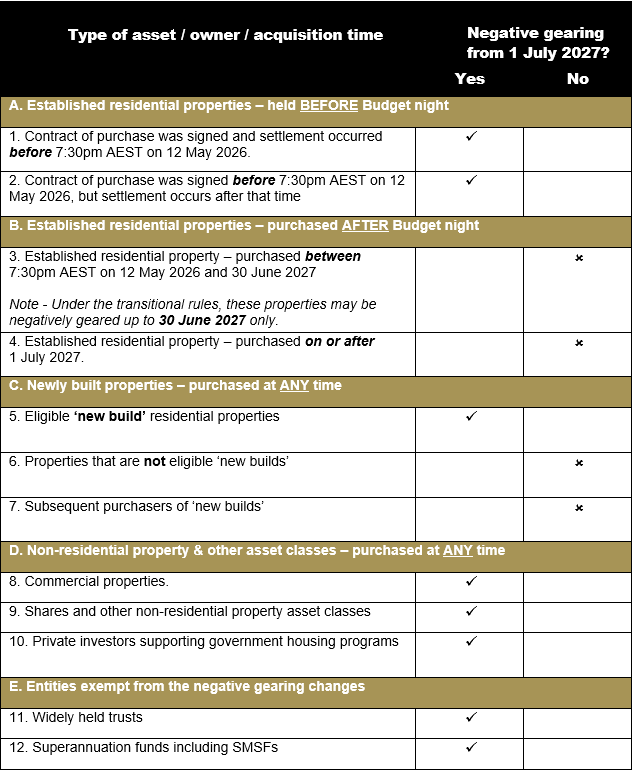
Here’s a simple overview of how the changes are expected to apply from 1 July 2027.
Unsure about your next property move?
If you’re considering a property purchase or want to understand how the changes could affect an existing investment strategy, speak with the Financially Sorted team before making any decisions.